
Case Study
How Virtua Health Transformed Procedural Supply Chain Operations with VueTrack

A Clinician-Driven Model for Inventory Visibility, Documentation, and Accountability
Virtua Health’s objective was to transform the perioperative experience for clinicians by removing friction from daily workflows, taking supply management off their to-do list, and improving documentation accuracy.
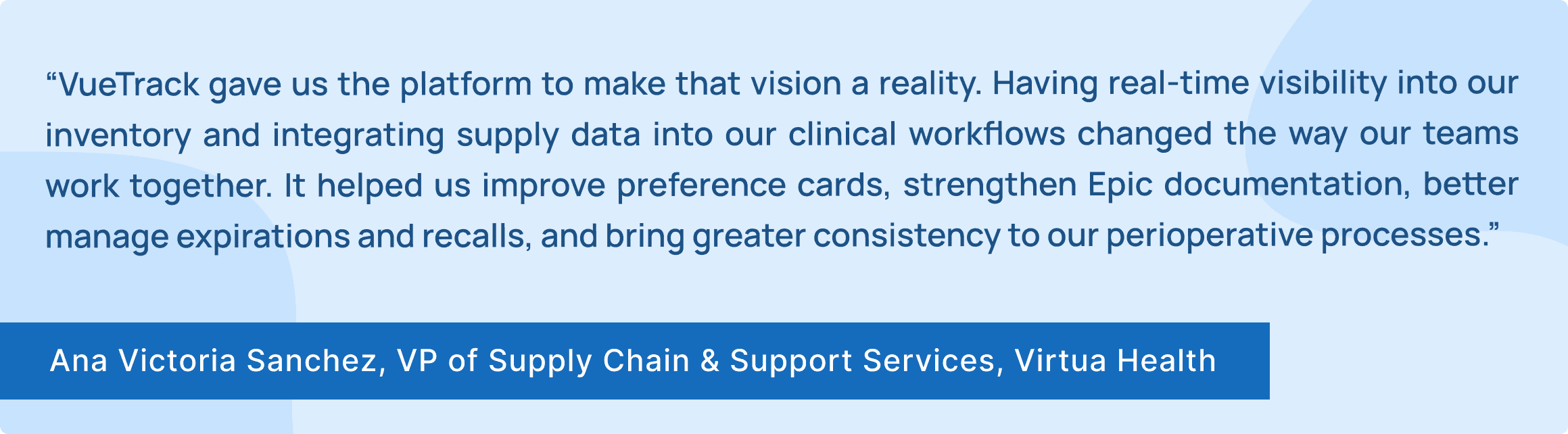
VueTrack™ became a critical enabler of that transformation, providing real-time, item-level visibility and integrating seamlessly into clinical and operational workflows.
$1.2M
Maximized revenue capture
by improving supply
documentation
$300K
Expiration savings
$100K
Avoided wrong orders
1,000 sq. ft.
Reduction in inventory overflow space
3:1 ROI
Validated at the initial site, projected to reach 5:1 across the enterprise
The Customer
Virtua Health is an academic, not-for-profit health system serving South Jersey. It is the largest health system in that area, with five hospitals, two satellite emergency departments, more than 40 ambulatory surgery centers, and more than 400 other locations.
Virtua’s procedural areas manage high-value supplies essential to patient care, procedure readiness, documentation accuracy, revenue integrity, and waste reduction. Project planning began in early 2024. The initial full implementation was completed at Virtua Our Lady of Lourdes Hospital in 2025, with expansion underway across all Virtua hospitals throughout 2026.
The Challenge
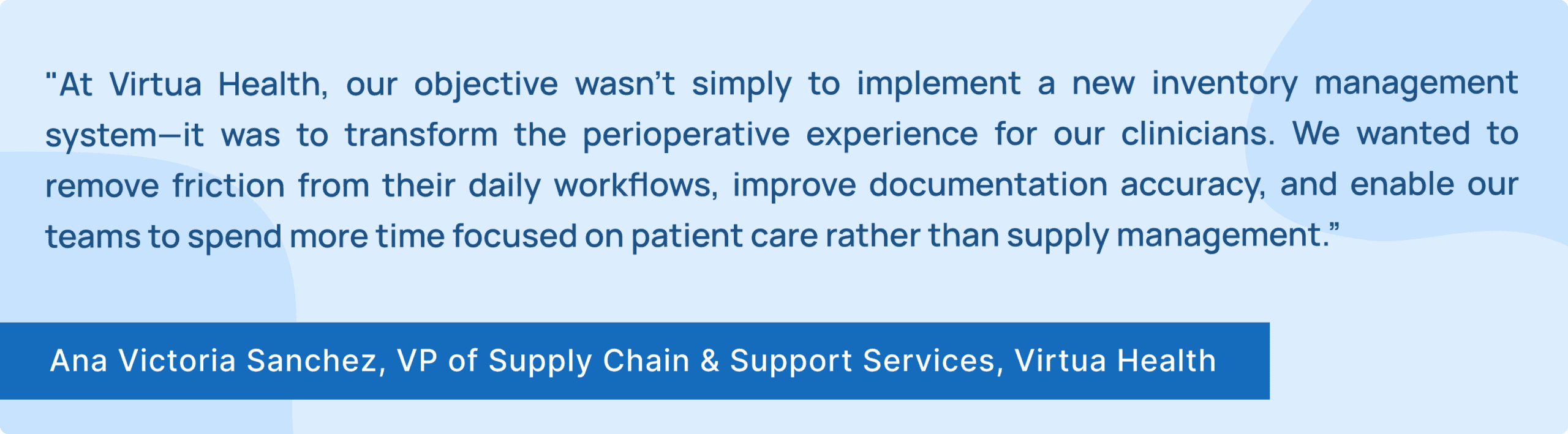
Before the initiative, Virtua’s perioperative and procedural departments faced a fragmented and manual supply management environment. An operational assessment identified five core challenges: lack of reliable inventory visibility, limited visibility into order management and fulfillment, fragmented roles and responsibilities, cumbersome clinical documentation, and inefficient organization of supplies and trays.
Clinical staff relied on manual counts, individual memory, phone calls, vendor follow-up, and just-in-case ordering to prepare for cases. There was no reliable real-time view of on-hand inventory, item locations, transfers, removals, consumption, consignment status, backorders, or order fulfillment.
This created operational and financial pressure. High-value supplies were difficult to track, preference cards were inconsistent, consignment inventory required better oversight, expirations and recalls depended on manual vigilance, and documentation gaps affected charge capture and revenue integrity.
The burden also fell heavily on clinicians. Clinical teams were pulled into ordering, restocking, searching, counting, checking expirations, tracking recalls, following up on delayed orders, and correcting documentation errors.
Documentation at the point of care added another burden. Staff had to enter supplies line by line, type lot and serial numbers, save implant stickers, review preference card lists, and correct missing or inaccurate information. These manual steps created audit work, delayed charge submission, affected billing, and weakened data for replenishment and forecasting.
The Solution
Virtua implemented VueTrack across surgery, cath lab, electrophysiology, interventional radiology, and endoscopy to capture item-level supply use at the point of care.
VueTrack was integrated with Virtua’s Epic electronic health record, Oracle enterprise resource planning system, and warehouse/materials management systems. This enabled supply documentation and inventory data to support operative record accuracy, automated replenishment, billing workflows, inventory visibility, reporting, and analytics.
Virtua paired the technology with an operating model change. Routine inventory responsibilities shifted away from clinicians and into a standardized supply chain model. The supply chain team assumed greater responsibility for inventory accuracy, replenishment, expiration review, recall tracking, consignment management, par-level optimization, preference card improvement, opened-but-unused item review, billing and data validation, and recurring reconciliation.
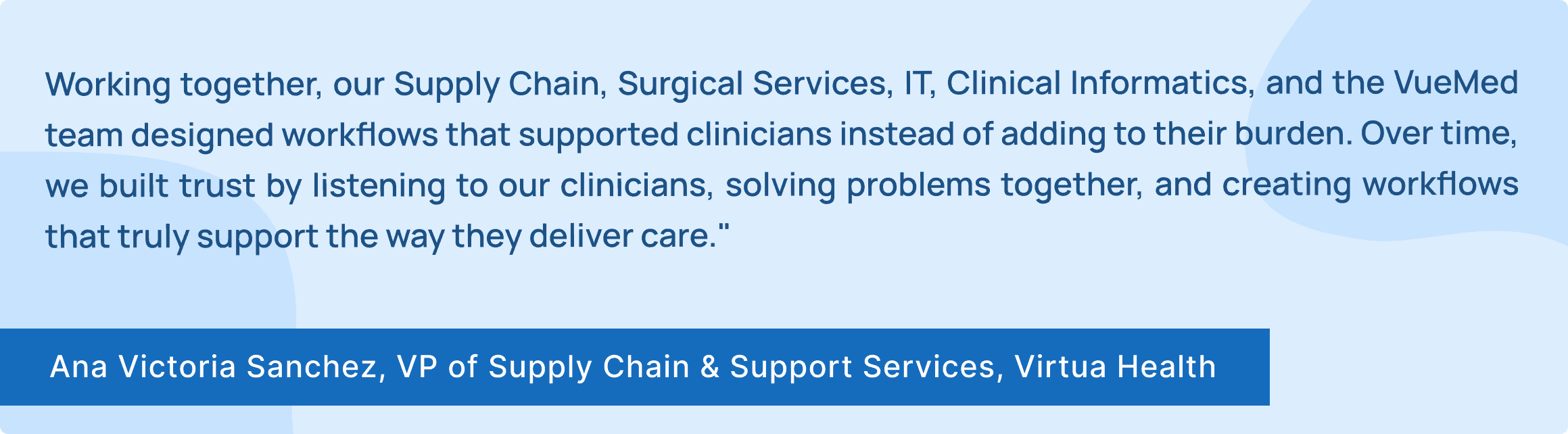
Clinical Informatics bridged clinical needs, documentation requirements, barcode scanning workflows, system integration, reporting, and user adoption. Clinical leaders and frontline users were engaged from the beginning to ensure that the redesigned workflows supported procedural care rather than adding burden.
A Clinician-Centered Operating Model
Virtua approached the project as a clinician-driven transformation rather than a back-office inventory initiative. The goal was to make supplies easier to find, easier to document, and more reliably available, while creating the data infrastructure and accountability needed to manage high-value procedural supplies.
Clinician feedback shaped the implementation, including ease of data capture, reduced manual entry, more accurate operative records, improved preference card accuracy, minimally disruptive point-of-use workflows, and better alignment between clinical care, supply documentation, and supply chain accountability.
This approach supported adoption because the new process solved real workflow problems, reduced friction in the daily experience of providing care, and improved supply data, inventory management, and documentation.
The Results
After 12 months at the initial implementation site—which required operational readiness and incorporated Cloud ERP go-live requiring extending the timelines—Virtua achieved measurable financial and operational improvements:
- $1.2 million in maximized revenue capture
- $300,000 in expiration savings
- $100,000 in avoided wrong orders
- 1,000-square-foot reduction in inventory overflow space
- 3:1 validated ROI at the initial site, projected to reach 5:1 across the enterprise
The initiative also produced broader operational gains:
- Improved visibility and accountability for high-value clinical supplies
- Stronger expiration management and recall control
- More accurate and complete operative record documentation
- Optimized par levels and preference cards
- Improved consignment inventory management
- Reduced clinician involvement in supply logistics and manual documentation tasks
- Better supply data to support replenishment, forecasting, reporting, and analytics
These improvements strengthened revenue integrity, reduced waste, improved space utilization, and created more reliable oversight of expirations, recalls, and consignment inventory. They also reduced non-value-added work for clinicians by shifting routine inventory management to supply chain and standardizing recurring processes.
What Sets This Approach Apart
The value of the initiative came from combining point-of-use technology with operational discipline and clinical engagement.
VueTrack provided the digital foundation for capturing supply use at the moment of care and connecting supply data to clinical, financial, and operational systems. Virtua’s cross-functional model ensured that the technology supported clinical workflows, strengthened accountability, and created reliable recurring processes.
The model brought together point-of-use scanning, item-level data capture, Epic documentation integration, ERP and warehouse/materials management integration, real-time inventory visibility, automated replenishment support, expiration and recall tracking, consignment oversight, item master validation, supply chain ownership, clinical informatics support, clinician-centered workflow design, reporting, and analytics.
The result was a clinically integrated supply chain operating model designed to improve financial performance, reduce waste, support procedure readiness, and make daily workflows easier for clinicians.
What's next
Virtua is now expanding the perioperative point-of-use system across the health system, extending the model beyond the initial implementation site.
The organization is also broadening the scope of supply areas managed by supply chain through a joint effort with hospital chief nursing officers, further shifting routine inventory responsibilities into a standardized operating model.
A Scalable Model for Health Systems
Virtua’s experience shows that procedural supply chain transformation can be a strategic lever for health system performance. High-value supplies are not merely inventory assets; they affect procedural readiness, revenue integrity, documentation accuracy, waste reduction, clinician efficiency, and the ability to meet growing care demands.
For other hospitals and health systems, the model is transferable. Replication requires executive sponsorship, clinical leadership engagement, a readiness assessment, IT and informatics partnership, reliable item master data, defined ownership of inventory tasks, standardized workflows, and digital tools capable of point-of-use capture and integration with clinical and operational systems.
See How VueTrack Supports Clinically Integrated Supply Chain Transformation
VueTrack helps hospitals capture supply use at the point of care, strengthen documentation accuracy, improve inventory visibility, support replenishment and billing workflows, and create a more connected supply chain across procedural care settings.
To learn how VueTrack can support your organization’s supply chain transformation, contact VueMed.