How real-time RFID tracking is helping hospital supply chains move toward a more automated future
For years, hospitals have invested in technology to improve inventory management. Yet in many supply rooms, much of the work remains manual. Someone still has to scan. Someone has to notice that inventory is running low, identify products approaching expiration, track down missing items, and make sure that what was used during a procedure gets documented correctly.
That is why a recent prediction from Gartner caught our attention. Gartner says that healthcare supply chains should begin preparing for a future in which manual inventory processes give way to more self-managing supply rooms — environments where technology continuously monitors supplies and increasingly initiates action without waiting for someone to perform another inventory task. The most interesting part of Gartner’s argument isn’t really about artificial intelligence. It’s about removing work.
What caught our attention was Gartner’s suggestion that hospitals evaluate technology by the work it removes, not just the work it improves. A system should not just make an old process faster. It should reduce the amount of work required in the first place so that staff can focus their time on more value-added tasks.
There is another part of the equation that matters just as much, and it gets less attention: integration. A recent editorial in BMJ Health & Care Informatics made the point that the real challenge with digital health is often not innovation itself, but how well technology is integrated into clinical workflows and organizational processes. In our experience, this is where most implementations either earn their keep or quietly fail.
Automation Shouldn’t Just Make Existing Tasks Easier
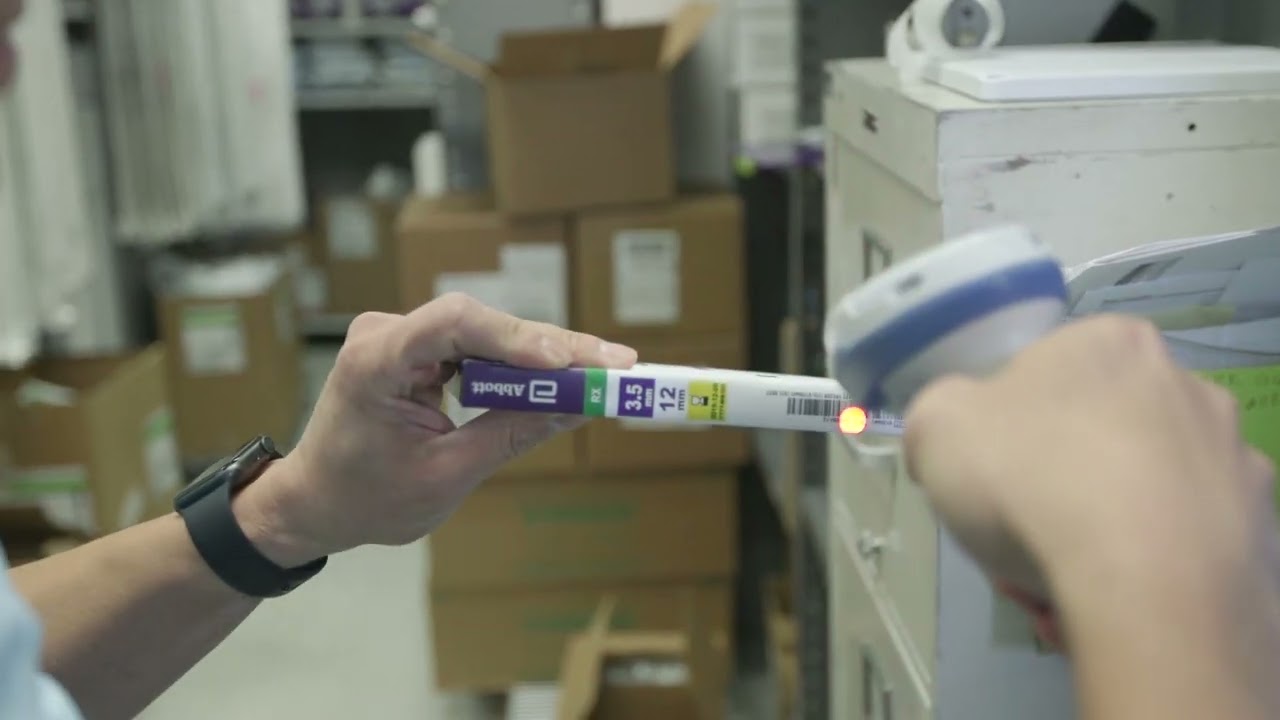
Barcode systems were an enormous improvement over paper-based inventory management. But a barcode still requires someone to find an item and scan it. Many inventory technologies work the same way — they digitize a manual process without necessarily eliminating it.
The better question isn’t how we can help staff manage inventory more efficiently. It’s how much of that work the system can handle on its own.
VueTrack-RF was built around that idea. Using passive RAIN RFID tags and an overhead antenna infrastructure, VueTrack-RF continuously tracks the movement and location of medical devices and supplies within a monitored area. Inventory visibility doesn’t depend on a staff member walking through with a scanner. The system captures that information automatically and in real time, at 99.5% precision, with no manual effort required for ongoing monitoring. And because it works with existing shelves and storage, creating an RFID-enabled environment doesn’t require replacing an entire supply room with proprietary cabinets.
Knowing What You Have Is Only the Beginning
At Loma Linda University Health, VueTrack-RF was implemented in the cardiovascular department, where inventory visibility and supply documentation had been major challenges. Before implementation, fewer than half of cases had accurate supply data captured, and more than half of the inventory on hand had no traceable purchase history. Supply chain, clinical, finance, and IT teams were working with fragmented processes and limited shared visibility — a problem more common than most health systems would like to admit.
VueTrack-RF was connected to clinical documentation and materials management systems, creating a complete flow of information from purchase through utilization and billing. The results were measurable: Loma Linda supported greater case volume without significantly increasing on-hand inventory, expired inventory fell to less than 1% of total inventory value, unused inventory above recommended PAR levels dropped by more than 60%, and billing accuracy increased to more than 90%.
The patient-safety impact was just as significant. Recalled products could be traced to patients in seconds, expired devices were prevented from reaching patients, and electronic medical records became more accurate and complete.
The staff still make decisions. They still manage the department. But they are no longer spending the same amount of time physically checking what is on the shelf or reconstructing what happened after the fact. That time goes somewhere more useful.
A Supply Room That Knows What’s Happening
When inventory is continuously tracked, supply chain teams can maintain appropriate PAR levels rather than carrying excess inventory as a buffer against uncertainty. Products approaching expiration can be identified before they become waste. Recalls can be handled faster. Replenishment decisions can be based on reliable real-time data rather than periodic manual checks.
Supply chain professionals can spend less time physically verifying what’s on a shelf and more time understanding why inventory is moving the way it is, whether PAR levels match actual clinical demand, where waste is occurring, and how purchasing decisions can be improved. That is the shift from visibility to something more valuable — the ability to act on what you know before a problem develops.
Gartner describes a future in which supply rooms can sense inventory conditions, anticipate demand, and increasingly trigger action with minimal human involvement. RAIN RFID provides an important foundation for that kind of environment. VueTrack-RF can turn a supply room, procedure room, or warehouse into a controlled inventory area using existing infrastructure — automatically monitoring product movement and creating a real-time record that supports replenishment, expiration management, recalls, documentation, and billing.
That does not mean every hospital supply room is suddenly fully autonomous. But it represents a meaningful change in operating model: the inventory system does the monitoring instead of waiting for a person to do it.
What Should Healthcare Organizations Be Asking?
The rush toward AI and automation will produce a lot of new technology — and a lot of new claims. A better way to evaluate those claims is to ask what actually changes for the people doing the work. Does the technology reduce manual inventory monitoring? Does it identify expirations before products become waste? Does it improve replenishment decisions without requiring staff to physically inspect hundreds of inventory locations? Does it give clinicians and supply chain teams a more accurate picture of what is happening in real time?
Those questions matter more than whether a solution carries the latest technology label. Healthcare supply chain teams are being asked to manage more products, across more locations, with continuing pressure on labor and cost. The answer cannot simply be asking people to do the same work faster. It has to be finding ways for technology to take more of that work off their hands.
That is the shift from inventory visibility to inventory autonomy. And it is already underway.
Share this Post:
Featured Stories On Our Minds
Healthcare Supply Chain Software: Features, Types & How to Choose
Hospital materials management: What Procedural Supply Data Reveals